Digital Onboarding vs Traditional KYC: What's Changing in 2026 ?
In today's digital-first world, customer expectations are evolving faster than ever. Whether opening a bank account, signing up for an investment platform, or accessing financial services, customers expect a seamless and convenient experience. This shift has placed Digital Onboarding at the center of customer acquisition strategies across industries.
For years, traditional KYC processes served as the foundation of regulatory compliance. However, as businesses seek faster, more efficient ways to onboard customers, digital onboarding has emerged as the preferred approach. In 2026, the conversation is no longer about whether organizations should adopt digital onboarding, but how quickly they can implement it.
This article explores the differences between traditional KYC and digital onboarding, the trends shaping customer onboarding in 2026, and why businesses are embracing digital-first onboarding experiences.
What Is Traditional KYC?
Know Your Customer (KYC) is a regulatory process used by financial institutions and regulated entities to verify the identity of customers before providing services.
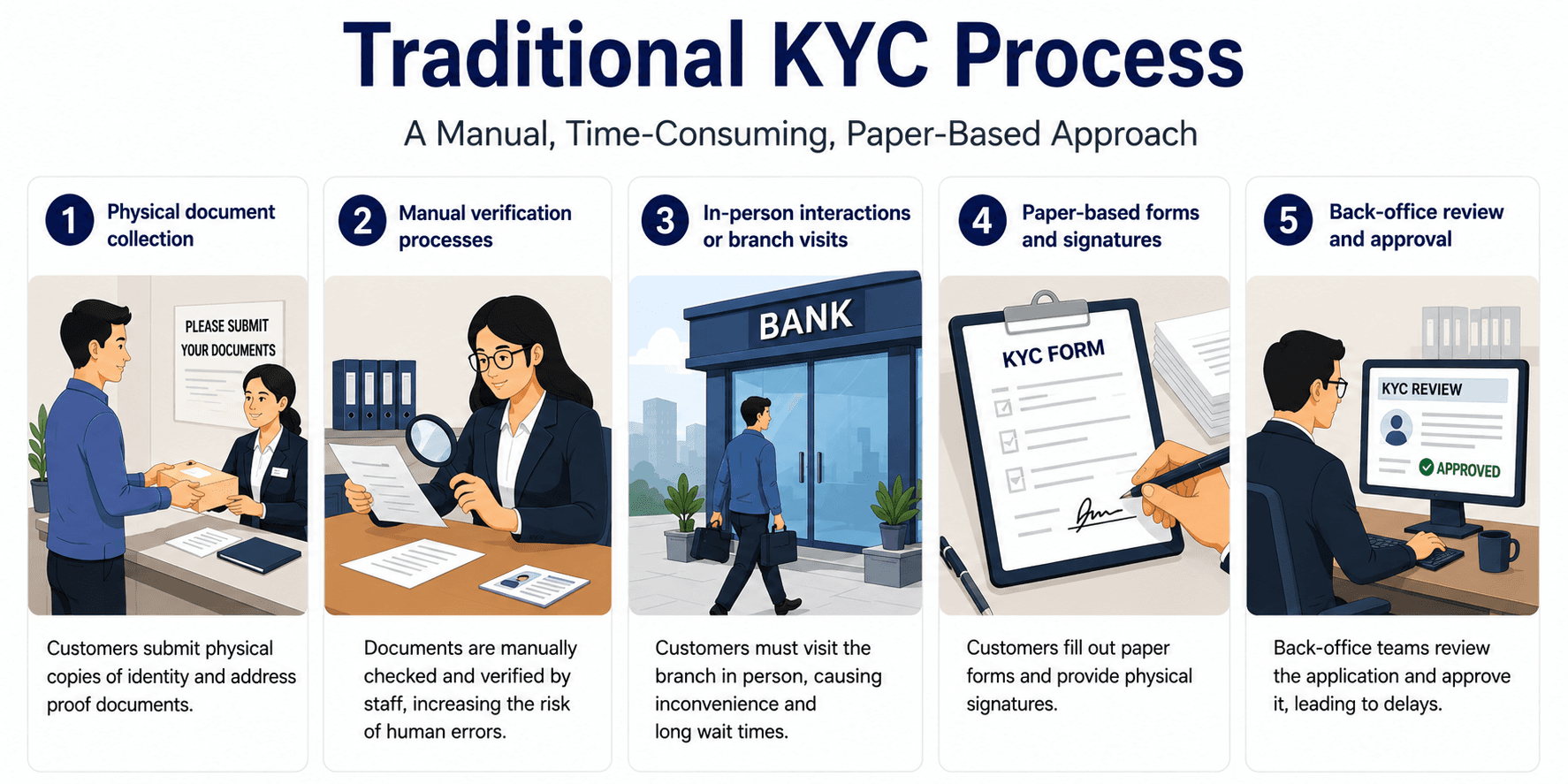
Traditional KYC typically involves:
- Physical document collection
- Manual verification processes
- In-person interactions or branch visits
- Paper-based forms and signatures
- Back-office review and approval
While this approach helps organizations meet compliance requirements, it often creates friction for customers. Completing multiple forms, submitting physical documents, and waiting for approvals can result in a slow and cumbersome onboarding experience.
As customer expectations continue to rise, businesses are finding it increasingly difficult to balance compliance requirements with convenience using traditional methods alone.
What Is Digital Onboarding?
Digital Onboarding is the process of acquiring, verifying, and activating customers through a fully digital journey.
Unlike traditional KYC, digital onboarding combines identity verification, compliance checks, document validation, and account activation into a streamlined experience that can often be completed within minutes.
The growing importance of digital onboarding is closely linked to the rapid expansion of the eKYC ecosystem. The India eKYC market is projected to grow at a CAGR of 19.52%between 2026 and 2034, highlighting the increasing demand for automated identity verification and compliance solutions.
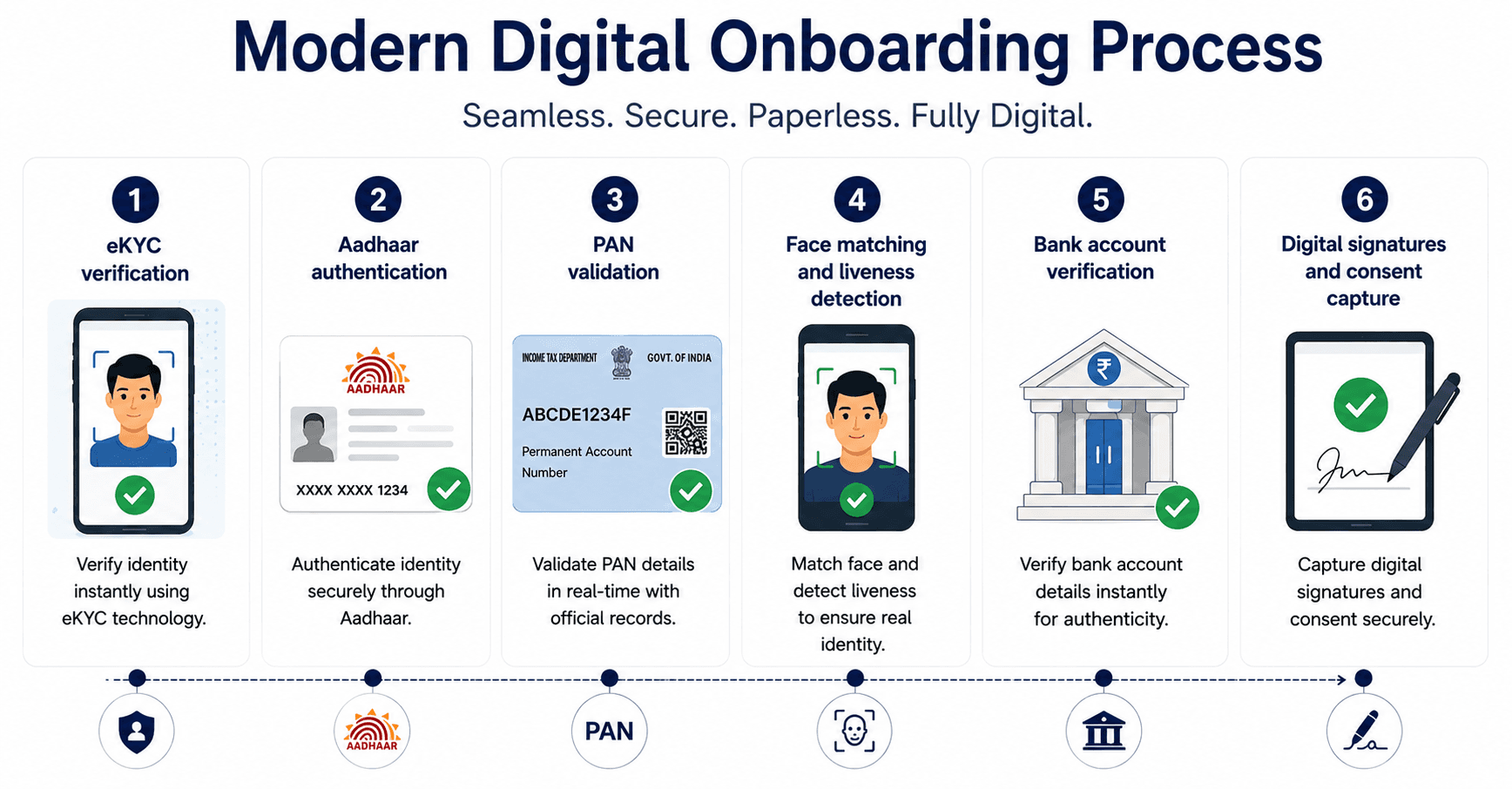
A modern digital onboarding process may include:
- eKYC verification
- Aadhaar authentication
- PAN validation
- Face matching and liveness detection
- Bank account verification
- Digital signatures and consent capture
The goal is simple: make customer onboarding faster, more secure, and more convenient while maintaining regulatory compliance.
Digital Onboarding vs Traditional KYC
While both approaches serve the same purpose, verifying customer identity and ensuring compliance, the experience and operational efficiency differ significantly.
Processing Speed
Traditional KYC often involves multiple manual checkpoints that can delay account activation. Customers may wait hours or even days for verification and approval.
Digital onboarding automates many of these steps, allowing businesses to complete KYC verification and digital account opening in real time.
Customer Experience
Traditional onboarding can require customers to repeatedly enter information, upload documents, and wait for verification updates.
Digital onboarding offers a mobile-first experience with guided workflows, real-time validation, and instant status updates, reducing frustration and improving completion rates.
Operational Efficiency
Manual KYC processes require significant operational effort. Teams must review documents, verify information, and manage approvals.
Digital onboarding reduces manual intervention through automation, allowing organizations to process larger volumes of customer applications without increasing operational costs.
Scalability
As businesses grow, traditional onboarding workflows often become difficult to manage.
Digital onboarding platforms are designed to scale, enabling organizations to onboard thousands of customers efficiently while maintaining compliance standards.
What's Changing in 2026?
The evolution of digital onboarding is being driven by a combination of technology, regulatory advancements, and changing customer expectations.
Faster eKYC Verification
Modern eKYC solutions now enable organizations to validate identity information almost instantly. Automated integrations with government databases and verification services have significantly reduced onboarding times.
As a result, customers expect account activation within minutes rather than days.
Video KYC Becomes Mainstream
Video KYC has become an increasingly important part of digital onboarding.
By allowing customers to complete identity verification remotely, businesses can reduce dependency on physical interactions while maintaining strong compliance controls.
By allowing customers to complete identity verification remotely, businesses can reduce dependency on physical interactions while maintaining strong compliance controls.
This has proven particularly valuable for financial institutions, stockbrokers onboarding and fintech companies seeking to expand their customer base across multiple locations.
Mobile-First Customer Onboarding
Today's customers primarily interact through smartphones.
Organizations are therefore redesigning customer onboarding journeys around mobile experiences, focusing on:
- Simpler workflows
- Fewer form fields
- Faster verification
- Clear progress indicators
- Instant notifications
Businesses that fail to deliver mobile-friendly onboarding experiences risk losing customers to competitors that do.
Enhanced Fraud Prevention
Security remains a critical component of digital onboarding.
Advanced technologies such as biometric authentication, face matching, liveness detection, and AI-powered document verification are helping organizations strengthen fraud prevention without introducing unnecessary friction.
This enables businesses to improve both security and customer experience simultaneously.
Greater Regulatory Alignment
Regulators continue to encourage secure digital verification mechanisms that improve accessibility while maintaining compliance.
This has accelerated the adoption of digital onboarding frameworks that integrate KYC verification, consent management, audit trails, and document storage into a single ecosystem.
Why Businesses Are Choosing Digital Onboarding
The shift toward digital onboarding is driven by measurable business outcomes.
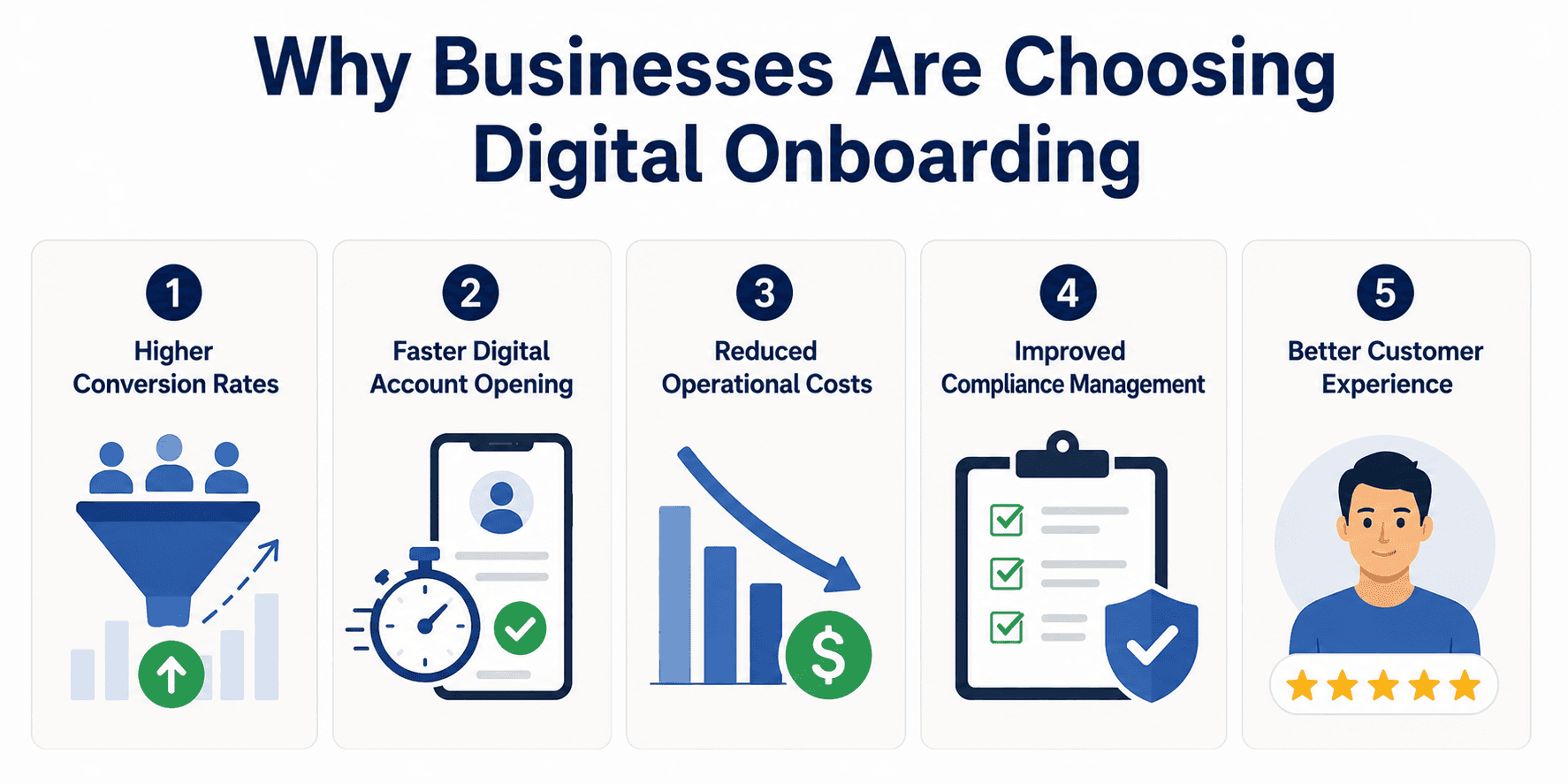
Higher Conversion Rates
Every additional step in the onboarding journey increases the risk of customer abandonment.
Digital onboarding simplifies the process, helping businesses convert more prospects into active customers.
Faster Digital Account Opening
Customers increasingly expect immediate access to services.
By reducing verification delays, digital onboarding enables faster digital account opening and quicker customer activation.
Reduced Operational Costs
Automation eliminates many repetitive tasks associated with manual KYC processes.
This reduces operational overhead while allowing teams to focus on higher-value activities.
Improved Compliance Management
Digital onboarding solutions maintain centralized records, audit trails, and verification logs, making compliance management more efficient and reliable.
Better Customer Experience
A seamless onboarding experience creates a positive first impression and strengthens customer confidence from the very beginning.
Is Traditional KYC Still Relevant?
Traditional KYC is not disappearing entirely.
Certain customer segments, high-risk profiles, and specialized use cases may still require additional manual verification steps. However, the broader trend is clear: organizations are increasingly embedding KYC verification within digital onboarding frameworks rather than treating it as a separate process.
The future is not traditional KYC versus digital onboarding. The future is KYC delivered through digital onboarding.
Conclusion
The way businesses acquire and verify customers is undergoing a significant transformation. While traditional KYC laid the foundation for regulatory compliance, Digital Onboarding is redefining how organizations deliver customer experiences in 2026.
By combining eKYC, automated KYC verification, seamless customer onboarding, and faster digital account opening, businesses can improve conversion rates, reduce operational costs, and strengthen compliance simultaneously.
As customer expectations continue to evolve, organizations that invest in digital onboarding will be better positioned to build trust, accelerate growth, and deliver the seamless experiences modern customers demand.